
Most organisations don’t struggle because they lack strategy. They struggle getting their strategy off the deck. It always start with high vibes and good intentions. A solid direction, a big ambition, and a leadership team that’s a 100% on board.
The deck is fire.
But over time, the flames fade, the energy diminishes, and momentum is lost.
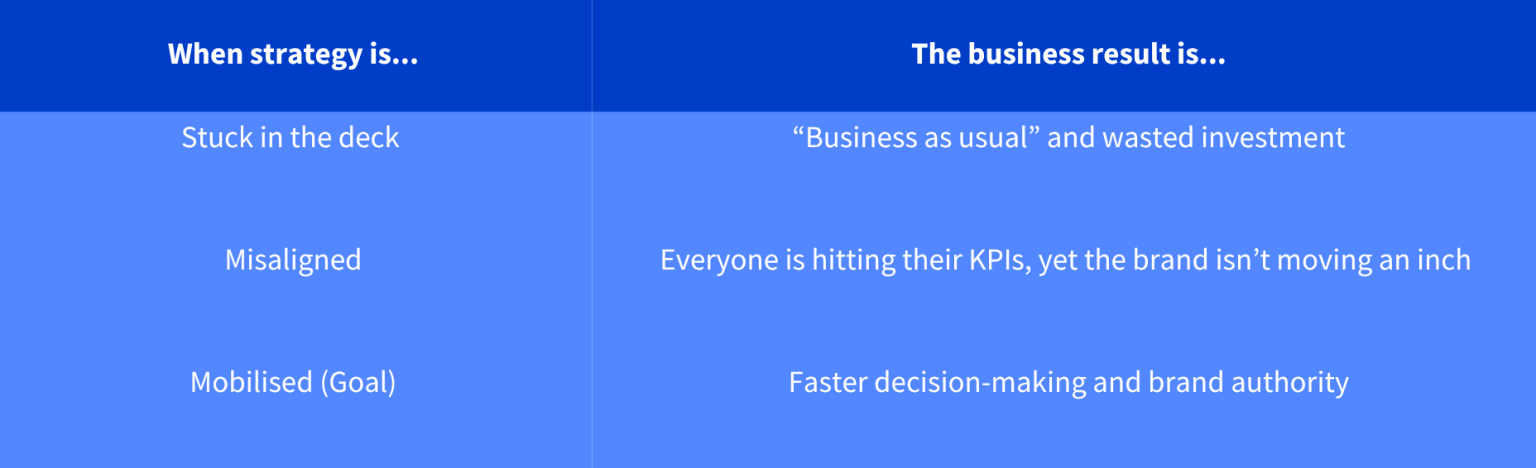
Different stakeholders interpret the strategy in different ways, priorities begin to drift, messages lose their consistency, and the original intent becomes harder to recognise. Eventually, that brand strategy becomes just another document sitting in a shared folder, needing updating – and the cycle begins again. And the problem isn’t the strategy itself. It’s what happens after the deck is finished.
The real challenge: alignment
In complex organisations, misalignment is almost inevitable.
There are multiple teams, multiple priorities and multiple pressures. Leadership teams are thinking long-term. Operational teams are focused on delivery. Sales, marketing and product teams might use the same language, but mean different things.
This doesn’t mean the strategy is wrong or bad.
It just means it hasn’t been made usable yet.
A useful strategy creates a shared source of truth across the organisation. People understand the vision, why it’s meaningful to them and how they can contribute to it. They want to belong, they want to play their part.
When brands start to drift, it’s rarely because people don’t care; it’s more likely they are filling in the gaps themselves – making it work for them.
The real opportunity: mobilisation
The strategy presentation is only the beginning.
It comes to life when people participate in shaping the thinking and understand their role in supporting it.
When key stakeholders are involved in developing the strategy, something important happens.
They don’t just understand it.
They support it.
And when people support a strategy, they start reinforcing it through their decisions, communication and behaviour.
That’s when strategy begins to travel across the organisation.
The most expensive document in a B2B organisation is a brilliant strategy that nobody knows how to use
Why this matters so much in B2B
In B2B industries, complexity is part of the job. Long sales cycles, a lot of technical details, and many stakeholders involved. This complexity makes it very easy for your message to get lost.
When strategy is clear and shared:
- Decisions are easier to make
- Communication feels more confident
- Brands show up more consistently
- Trust builds over time
Not because things are simplified, but because intent is clear.
Our final thoughts
After more than two decades working with businesses of all sizes and sectors, we’ve learned something simple: strategy suffers because it never becomes something people can actually relate to and use. The cost is an opportunity loss. It’s what might have happened if there was really effective alignment and mobilisation.
The real work is making sure it travels across the organisation, aligning people, decisions and communication around a shared intent.
At Threesixty, that’s exactly where we work.
If you have a strategy that makes sense on paper but feels harder to apply in reality, let’s talk.